| |
|
|
|
|
|
| |
My Confession |
| Description: |
|
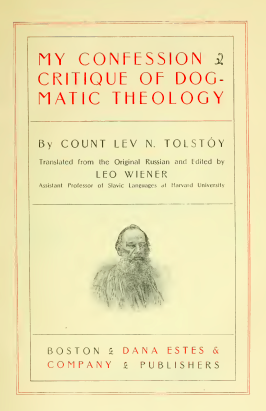
My Confession is Tolstoy’s deeply personal spiritual autobiography, in which he reflects on his existential crisis during midlife. Despite fame and literary success, he found himself haunted by the question: “What is the meaning of life?” Struggling with despair and thoughts of suicide, Tolstoy turned away from the Church and intellectual philosophy, ultimately discovering purpose in the faith and simplicity of the common people. |
|
 |
PDF
EPUB |
| Date: |
|
1879–82 |
|
| Reference: |
|
The complete works of Count Tolstoy. Vol. 13 |
|
| Extent: |
|
50 p. |
|
| Tags: |
|
Non-fiction, Religion, Philosophy, Autobiographical |
|
| |
| |
The Critique of Dogmatic Theology |
| Description: |
|
In The Critique of Dogmatic Theology, Leo Tolstoy offers a powerful and systematic rejection of orthodox Christian doctrine, especially as presented by the Russian Orthodox Church. Drawing on the Gospels, especially the teachings of Jesus, he argues that institutional religion has distorted the true moral and spiritual message of Christianity.
He condemns dogmas such as the Trinity, original sin, and eternal punishment as incompatible with reason and Christ’s teachings. The essay reflects Tolstoy’s commitment to a rational, ethical, and nonviolent interpretation of Christianity, forming the basis of his later religious philosophy and Christian anarchism. |
|
|
PDF
EPUB |
| Date: |
|
1881-82 |
|
| Reference: |
|
The complete works of Count Tolstoy. Vol. 13 |
|
| Extent: |
|
228 p. |
|
| Tags: |
|
Non-fiction, Religion, Philosophy |
|
| |
| |
My Religion |
| Description: |
|
My Religion is Tolstoy’s bold declaration of his personal faith, written after a deep spiritual crisis. Rejecting the doctrines of the Orthodox Church, he embraces the moral teachings of Jesus—especially the command to resist not evil—as the core of true Christianity. He calls for nonviolence, love for all people, rejection of war, oaths, and state authority. The book articulates the foundation of Tolstoy’s Christian anarchism and his belief that living according to Christ’s Sermon on the Mount is the only path to spiritual truth. Its radical message influenced pacifists worldwide, including Gandhi. |
|
 |
PDF
EPUB |
| Date: |
|
January 22, 1884 |
|
| Reference: |
|
The complete works of Count Tolstoy. Vol. 16 |
|
| Extent: |
|
137 p. |
|
| Tags: |
|
Non-fiction, Religion, Philosophy, Autobiographical |
|
| |
| |
Thoughts on God |
| Description: |
|
Thoughts on God is a collection of Tolstoy’s brief reflections, drawn from his diaries, essays, and letters, expressing his mature understanding of God, faith, and moral duty. Rather than focusing on dogma, Tolstoy presents God as the spiritual essence present in all life, accessible through love, truth, and selflessness. |
|
|
PDF
EPUB |
| Date: |
|
1885-1900 |
|
| Reference: |
|
The complete works of Count Tolstoy. Vol. 16 |
|
| Extent: |
|
16 p. |
|
| Tags: |
|
Non-fiction, Religion, Philosophy |
|
| |
| |
On the Meaning of Life |
| Description: |
|
On the Meaning of Life is a concise but profound statement of Tolstoy’s mature philosophy, drawn from his later writings. In it, he argues that life’s meaning cannot be found in wealth, fame, or pleasure, but only in living according to love, moral truth, and service to others. He rejects institutional religion, advocating instead for a personal faith grounded in the teachings of Jesus and the unity of all people. |
|
|
PDF
EPUB |
| Date: |
|
1885-1900 |
|
| Reference: |
|
The complete works of Count Tolstoy. Vol. 16 |
|
| Extent: |
|
30 p. |
|
| Tags: |
|
Non-fiction, Religion, Philosophy |
|
| |
| |
What Shall We Do Then? |
| Description: |
|
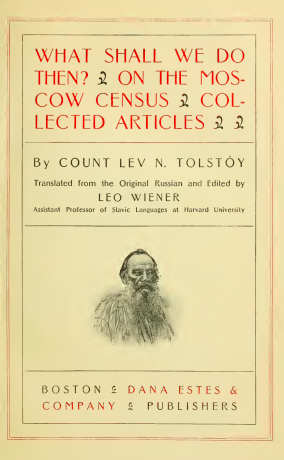
What Shall We Do Then? is Tolstoy’s urgent moral and social critique, written after he confronted the extreme poverty in Moscow. Disturbed by the contrast between wealthy elites and starving peasants, he asks how a moral person should live in such a society. Rejecting charity that preserves inequality, Tolstoy calls for personal renunciation of luxury, honest labor, and direct service to those in need. |
|
 |
PDF
EPUB |
| Date: |
|
1886 |
|
| Reference: |
|
The complete works of Count Tolstoy. Vol. 17 |
|
| Extent: |
|
207 p. |
|
| Tags: |
|
Non-fiction, Philosophy, Society & State, Autobiographical |
|
| |
| |
Thoughts and Aphorisms |
| Description: |
|
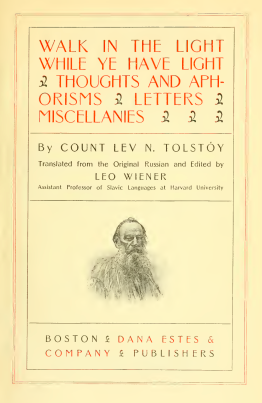
Thoughts and Aphorisms is a collection of brief reflections drawn from Tolstoy’s journals, letters, and essays. Covering themes such as truth, love, humility, faith, death, and the meaning of life, these concise entries express his mature moral and spiritual philosophy. |
|
 |
PDF
EPUB |
| Date: |
|
1886-93 |
|
| Reference: |
|
The complete works of Count Tolstoy. Vol. 19 |
|
| Extent: |
|
88 p. |
|
| Tags: |
|
Non-fiction, Philosophy, Autobiographical |
|
| |
| |
On Life |
| Description: |
|
On Life is a philosophical treatise in which Tolstoy examines the purpose and meaning of human existence. Rejecting materialism, self-interest, and institutional religion, he argues that true life is found in unity with the divine will, expressed through love, selflessness, and service to others. Tolstoy distinguishes between the “animal life” of bodily desires and the “true life” of the spirit. |
|
|
PDF
EPUB |
| Date: |
|
1888 |
|
| Reference: |
|
The complete works of Count Tolstoy. Vol. 16 |
|
| Extent: |
|
106 p. |
|
| Tags: |
|
Non-fiction, Religion, Philosophy |
|
| |
| |
Religion and Morality |
| Description: |
|
The essay argues that “religion” is each person’s felt relationship to the infinite and that any genuine morality grows from that relationship; to divorce the two is impossible. |
|
|
PDF
EPUB |
| Date: |
|
1894 |
|
| Reference: |
|
The complete works of Count Tolstoy. Vol. 19 |
|
| Extent: |
|
16 p. |
|
| Tags: |
|
Non-fiction, Religion, Philosophy |
|
| |
| |
Reason and Religion |
| Description: |
|
Reason and Religion is an essay in which Tolstoy examines the conflict between rational understanding and organized religion. He argues that true faith must align with reason and moral conscience, not blind obedience to church dogma or superstition. |
|
 |
PDF
EPUB |
| Date: |
|
1896 |
|
| Reference: |
|
The complete works of Count Tolstoy. Vol. 20 |
|
| Extent: |
|
4 p. |
|
| Tags: |
|
Non-fiction, Religion, Philosophy |
|
| |
| |
What Is Art? |
| Description: |
|
What Is Art? is Tolstoy’s influential treatise on aesthetics, in which he rejects the elitism and artificiality of modern art. He argues that true art is sincere, morally uplifting, and accessible to all people, not just the privileged. For Tolstoy, the value of art lies in its ability to communicate genuine human emotion and promote love, unity, and moral progress. He condemns works that serve vanity or sensual pleasure, calling instead for art that inspires goodness and compassion. |
|
 |
PDF
EPUB |
| Date: |
|
1897 |
|
| Reference: |
|
The complete works of Count Tolstoy. Vol. 22 |
|
| Extent: |
|
135 p. |
|
| Tags: |
|
Non-fiction, Art, Philosophy, Society & State |
|
| |
| |
Modern Science |
| Description: |
|
In Modern Science, Tolstoy criticizes contemporary science for being detached from moral purpose and human needs. He argues that scientific progress often serves power, wealth, and abstract curiosity, rather than improving the lives of ordinary people. |
|
 |
PDF
EPUB |
| Date: |
|
1897 |
|
| Reference: |
|
Modern Science |
|
| Extent: |
|
6 p. |
|
| Tags: |
|
Non-fiction, Society & State, Philosophy |
|
| |
| |
Preface to Carpenter’s Article, “Modern Science” |
| Description: |
|
In “Preface to Carpenter’s Article, ‘Modern Science,’” Tolstoy criticizes contemporary science for neglecting moral and spiritual questions. |
|
 |
PDF
EPUB |
| Date: |
|
1898 |
|
| Reference: |
|
The complete works of Count Tolstoy. Vol. 23 |
|
| Extent: |
|
7 p. |
|
| Tags: |
|
Non-fiction, Society & State, Philosophy |
|
| |
| |
The Slavery of Our Time |
| Description: |
|
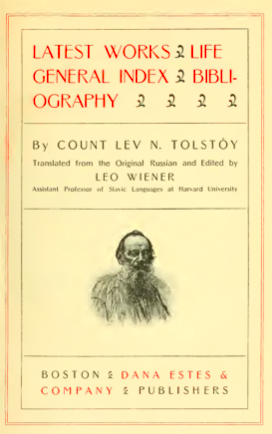
The Slavery of Our Time is Tolstoy’s passionate denunciation of modern economic and social inequality. He argues that industrial labor, poverty, and dependence on money have created a new form of slavery—less visible but just as cruel as the old. Tolstoy contends that this slavery persists because society accepts the exploitation of workers as normal. He calls for simplicity, honest labor, and moral awakening, urging people to live according to Christ’s commandment of love rather than greed. |
|
 |
PDF
EPUB |
| Date: |
|
1900 |
|
| Reference: |
|
The complete works of Count Tolstoy. Vol. 24 |
|
| Extent: |
|
46 p. |
|
| Tags: |
|
Non-fiction, Philosophy, Society & State |
|
| |
| |
What Is Religion? |
| Description: |
|
What Is Religion? is one of Tolstoy’s final and most comprehensive statements on faith and morality. In this work, he defines true religion as a personal, inner relationship with the divine—expressed through love, truth, and service to others—rather than adherence to dogma, ritual, or institutional authority. He contrasts genuine faith with the hypocrisy of organized churches, which he believed corrupted Christ’s simple moral teaching. |
|
|
PDF
EPUB |
| Date: |
|
1902 |
|
| Reference: |
|
The complete works of Count Tolstoy. Vol. 24 |
|
| Extent: |
|
32 p. |
|
| Tags: |
|
Non-fiction, Religion, Philosophy |
|
| |
| |
Demands of Love and Reason |
| Description: |
|
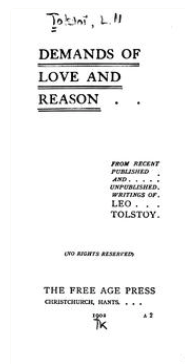
In The Demands of Love and Reason, Tolstoy argues that both human reason and the moral law of love lead to the same conclusion: one must reject violence, injustice, and participation in systems of coercion. |
|
 |
PDF
EPUB |
| Date: |
|
1902 |
|
| Reference: |
|
Demands of Love and Reason |
|
| Extent: |
|
12 p. |
|
| Tags: |
|
Non-fiction, Philosophy |
|
| |
| |
A Calendar of Wisdom: Daily Thoughts to Nourish the Soul, Written and Selected from the World's Sacred Texts (A Circle of Reading) |
| Description: |
|
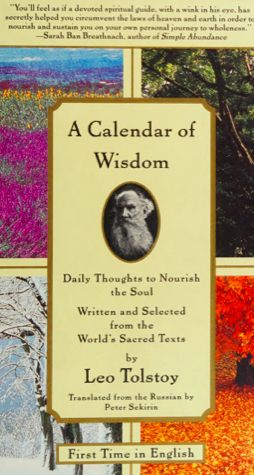
Fragments from the works of thinkers from different centuries, quoted or paraphrased by Tolstoy. |
|
 |
PDF
EPUB |
| Date: |
|
1906 |
|
| Reference: |
|
A Calendar of Wisdom: Daily Thoughts to Nourish the Soul, Written and Selected from the World's Sacred Texts (A Circle of Reading) |
|
| Extent: |
|
220 p. |
|
| Tags: |
|
Non-fiction, Philosophy |
|
| |
| |
Wise Thoughts for Every Day: On God, Love, the Human Spirit, and Living a Good Life |
| Description: |
|
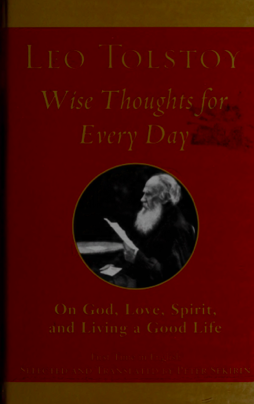
Fragments from the works of thinkers from different centuries, quoted or paraphrased by Tolstoy. |
|
 |
PDF
EPUB |
| Date: |
|
1909 |
|
| Reference: |
|
Wise Thoughts for Every Day: On God, Love, the Human Spirit, and Living a Good Life |
|
| Extent: |
|
192 p. |
|
| Tags: |
|
Non-fiction, Philosophy |
|
| |
| |
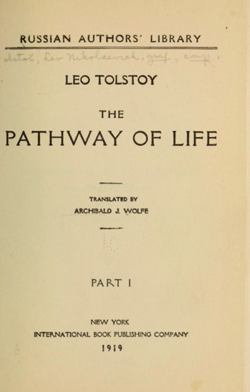
The Pathway of Life |
| Description: |
|
A religious-philosophical work written by Tolstoy in the final year of his life. |
|
 |
PDF
EPUB |
| Date: |
|
1910 |
|
| Reference: |
|
The Pathway of Life, Part I, II |
|
| Extent: |
|
275 p. |
|
| Tags: |
|
Non-fiction, Religion, Philosophy |
|
| |
| |